
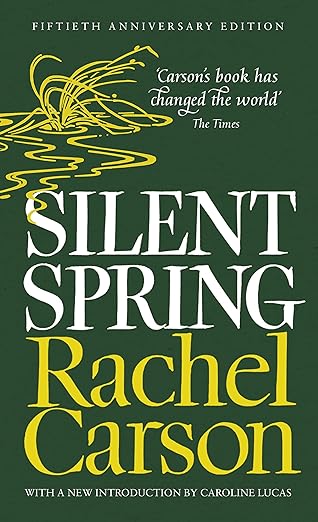
I want to big up Rachel Carson who began raising flags in 1940s about the false economy of synthetic chemical solutions and monoculture crop, versus sustainable practice. She wrote prolifically about it in 60s and was met with fierce opposition from chemical corporations.
In 1960s a number of scholars were challenging world views and their ideas and what they showed have helped shaped the lenses through which I understand the world. Thinkers and scientists from Lynn Margulis’ (Symbiotic Planet), James Lovelock (Gaia Hypothesis), to Rachel Carson (Silent Spring) amongst a number of others, and bit a little later in the 70s E.F Schumacher (‘Small is Beautiful: A Study of Economics As If People Mattered) and Fritjof Capra (The Tao of Physics).
Their ideas debunk much of the mechanistic thinking of 18th early 19th century that are still mainstream, those of descartes and neo-darwinian views that still exert on economics. These ‘schools’ dissect the world and study it in parts, with the individual part, at the centre based in separation, competition, (and fear). It ignores the role of reciprocity and the role of nurture. This leads inevitably to ecologically and socially destructive outcomes.
Lynn Margulis she showed that new life was created through the cooperation of organisms ‘symbio-genesis’ at the microbial level, rather than through their outcompeting (neo Darwinian) and pointed to the need for system’s view of the living world (see Fritjof Capra). The role of reciprocity within and between species in thriving can be seen everywhere in nature.
In my undergraduate dissertation, l saw how neoclassical economists, e.g Frederick Hayek attempted to legitimise the prevailing system of market capitalism based on wrong analogies with biological evolution and the presumption of optimal outcomes.
In 1962 in ‘Silent Spring’ Carson provides a critique of the prevailing economic logic. Her metaphor of a spring without birdsong illustrated the invisible nature of ecological breakdown. Carson noted how environmental damage can appear suddenly after long periods of accumulation and the interconnectedness of species and ecosystems through delicate webs of life that together create resilience and how humans are destroying that resilience.
Carson knew about the ecologically destructive outcomes of markets that ignore the essential role of our living world, nature and energy as a complex provisioning system, and raised alarm bells then about concern of poisonous chemicals. A key theme of her book relates to how the post-WWII boom in synthetic chemical production, particularly pesticides like DDT, represented an unprecedented experiment with our living world, human and non-human nature.
Carson was among the first to clearly explain the concept of bioaccumulation and food chain disruption and thus how seemingly isolated chemical use could have system-wide ecological impacts. She explained that pesticides accumulate in living tissues and become concentrated up the food chain: ‘biomagnification’, where toxins become more concentrated in predator species.
#elevateeconomics#ecosystems #sustainability #ecologicaljustice #planetaryblundaries #symbioticplanet #interdependence #emergence #cooperation #systemsthinking #ecologicaleconomics #elevateeconomics symbioticplanet #systemsthinking #ecologicaleconomics
 Elevate Economics
Leave a comment